⚠️ We are closely monitoring the recent Ebola outbreak in the Democratic Republic of the Congo. We extend our deepest sympathies to the Congolese people during this challenging time, and our thoughts and steadfast support remain with the affected communities.
Ophthalmology
MHF Patient Guide

Ophthalmology

Ophthalmology is a specialized branch of medicine focused on the diagnosis, treatment, and prevention of diseases and conditions affecting the eyes and visual system. It encompasses both medical and surgical interventions to address complex vision disorders, ranging from cataracts and glaucoma to retinal diseases and corneal disorders. For international patients seeking advanced care, ophthalmologists utilize cutting-edge diagnostic tools and minimally invasive surgical techniques to preserve, restore, or improve vision, ensuring a comprehensive approach to ocular health.

41
specialist profiles
6+
hospitals to explore
EN / FR
bilingual coordination
24–48h
initial response target

Understand the specialty

Clinical Overview and Direction

Ophthalmology is a specialized branch of medicine focused on the diagnosis, treatment, and prevention of diseases and conditions affecting the eyes and visual system. It encompasses both medical and surgical interventions to address complex vision disorders, ranging from cataracts and glaucoma to retinal diseases and corneal disorders. For international patients seeking advanced care, ophthalmologists utilize cutting-edge diagnostic tools and minimally invasive surgical techniques to preserve, restore, or improve vision, ensuring a comprehensive approach to ocular health.

Conditions Commonly Evaluated

  • Cataracts (clouding of the eye's lens)
  • Glaucoma (optic nerve damage often due to high eye pressure)
  • Macular degeneration (age-related central vision loss)
  • Diabetic retinopathy (retinal damage caused by diabetes)
  • Corneal diseases (such as keratoconus and corneal dystrophies)
  • Retinal detachment (separation of the retina from underlying tissue)
  • Strabismus (misalignment of the eyes)
  • Uveitis (inflammation of the middle layer of the eye)

When to Seek Urgent Local Care

Do not delay urgent care while arranging international travel.

  • Sudden, severe loss of vision in one or both eyes
  • Experiencing a sudden onset of flashes of light or numerous new floaters
  • Severe, unexplained eye pain accompanied by redness and nausea
  • A curtain-like shadow descending over your field of vision
  • Physical trauma or chemical injury to the eye

Diagnostics and Useful Records

Complete records help the clinical team prepare a more useful opinion before travel.

Comprehensive visual acuity testing
Slit-lamp examination (biomicroscopy) to view eye structures
Tonometry to measure intraocular pressure (IOP)
Optical Coherence Tomography (OCT) for cross-sectional retinal imaging
Fluorescein angiography to examine retinal blood circulation
Visual field testing to assess peripheral vision
Corneal topography for mapping the surface curvature of the cornea
Fundus photography to document the retina and optic nerve

Treatment Approaches to Discuss

Treatment depends on the confirmed diagnosis, overall health, investigations, goals and specialist-team assessment.

Phacoemulsification and intraocular lens (IOL) implantation for cataracts
Laser trabeculoplasty and minimally invasive glaucoma surgery (MIGS)
Intravitreal injections (anti-VEGF therapies) for macular degeneration
Vitrectomy for retinal detachment and severe diabetic retinopathy
Corneal transplantation (penetrating keratoplasty or endothelial keratoplasty)
Laser photocoagulation for retinal tears and vascular conditions
Refractive surgery (LASIK, PRK, or SMILE) for vision correction
Strabismus surgery to realign eye muscles

Selecting the Right Specialist

When selecting an ophthalmologist for advanced eye care abroad, patients should prioritize specialists who are board-certified and possess extensive fellowship training in their specific subspecialty, such as retina, cornea, or glaucoma. It is advisable to review the specialist's experience with the specific procedure required and the volume of similar cases they handle annually. Furthermore, choose a healthcare facility equipped with state-of-the-art diagnostic imaging and modern surgical suites, ensuring access to the latest technologies like femtosecond lasers and advanced intraocular lenses. A comprehensive approach that includes a dedicated international patient department to assist with language translation and logistical support is also highly beneficial.

Preparing for Evaluation

Preparing for an ophthalmological consultation or procedure involves compiling a complete medical history, including a list of all current medications, especially blood thinners, and previous eye surgeries. Patients should arrange for a family member or companion to accompany them, as diagnostic eye drops may temporarily blur vision and increase light sensitivity, making driving unsafe. It is important to bring any existing eyeglasses or contact lenses, as well as copies of recent eye scans or medical records if traveling internationally. Fasting may be required prior to surgical procedures under anesthesia, and specific instructions regarding the cessation of certain medications will be provided by the clinical team.

Recovery and Continuity of Care

Recovery following eye surgery requires strict adherence to the ophthalmologist's post-operative instructions to ensure optimal healing and prevent complications. Patients will typically need to administer prescribed antibiotic and anti-inflammatory eye drops at specific intervals and wear a protective eye shield, especially while sleeping, to prevent accidental rubbing. Activities that increase eye pressure, such as heavy lifting, bending over, or intense exercise, must be avoided during the initial healing phase. While some improvement in vision may be noticed immediately, full stabilization can take several weeks; regular follow-up appointments are essential to monitor intraocular pressure, assess healing progress, and make any necessary adjustments to treatment.

Discharge summary
Medication plan
Remote follow-up

Questions to Ask the Clinical Team

1What specific diagnostic tests are necessary to confirm my eye condition?
2What are the available treatment options, and what do you recommend for my specific case?
3What are the potential risks and complications associated with the proposed eye surgery?
4How long will the procedure take, and what type of anesthesia will be used?
5What should I expect during the recovery period, and when can I resume normal activities?
6Will I need multiple surgeries or long-term follow-up care for this condition?
7How long should I plan to stay in the country for post-operative monitoring before flying home?

Explore Profiles

Related Specialists

View all 41 profiles
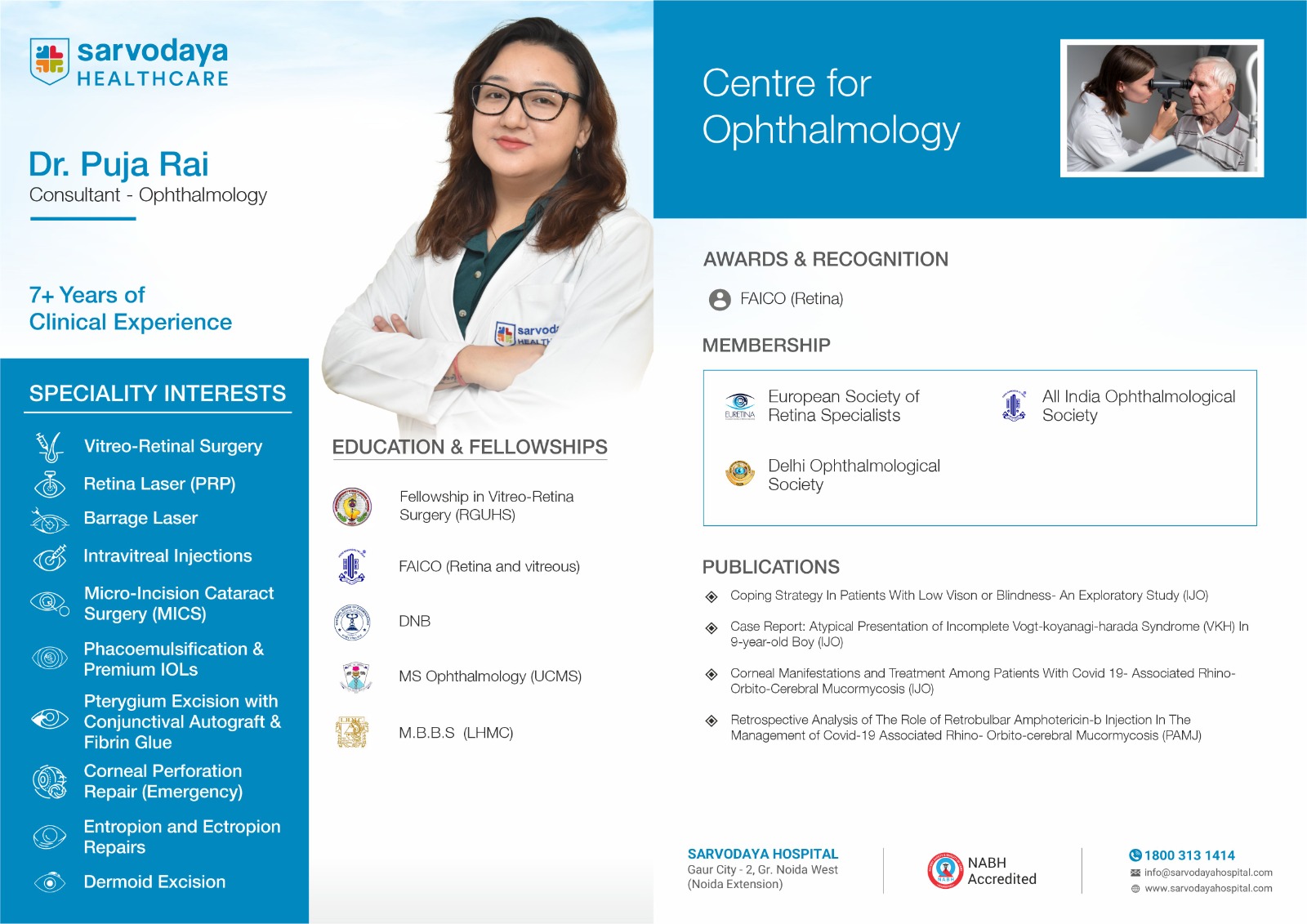
Dr. Puja Rai

Dr. Puja Rai

Consultant - Ophthalmology

Sarvodaya Hospital

View profile
Dr. Divya Bisht

Dr. Divya Bisht

Associate Consultant, Ophthalmology

Medanta - The Medicity

View profile
Dr. Naginder Vashisht

Dr. Naginder Vashisht

Consultant, Ophthalmology

Medanta - The Medicity

View profile
Dr. Nidhi Kaushal

Dr. Nidhi Kaushal

Senior Consultant Ophthalmology

Medanta - The Medicity

View profile
Dr. Rituraj Baruah

Dr. Rituraj Baruah

Consultant Ophthalmology

Medanta - The Medicity

View profile
Dr. Sameer Kaushal

Dr. Sameer Kaushal

Director, Ophthalmology

Medanta - The Medicity

View profile

Compare Facilities

Hospitals Offering This Specialty

FAQ

Frequently Asked Questions

Is cataract surgery painful?

Cataract surgery is generally not painful. Local anesthesia in the form of eye drops is used to numb the eye, and patients may receive a mild sedative to help them relax. You may feel some pressure during the procedure, but it is typically well-tolerated.

Can glaucoma be cured completely?

There is currently no complete cure for glaucoma, and vision lost to the disease cannot be restored. However, with early detection and appropriate treatment (such as eye drops, laser therapy, or surgery), the progression of the disease can be significantly slowed or halted, preserving remaining vision.

How soon after eye surgery can I fly back home?

The timing for air travel depends on the specific type of surgery performed. For many routine procedures like cataract surgery, flying may be permissible within a few days. However, for surgeries involving gas bubbles placed in the eye (such as certain retinal procedures), flying is strictly prohibited until the bubble has completely absorbed, which can take several weeks. Always consult your surgeon for clearance.

Will I still need glasses after cataract surgery?

This depends on the type of intraocular lens (IOL) implanted. Standard monofocal lenses typically correct vision for one distance (usually far), meaning you may still need reading glasses. Premium lenses, such as multifocal or toric IOLs, can reduce or eliminate the need for glasses by correcting presbyopia and astigmatism.

What is the difference between an ophthalmologist and an optometrist?

An ophthalmologist is a medical doctor (MD or DO) who specializes in eye and vision care, capable of diagnosing complex diseases, performing eye surgery, and prescribing medications. An optometrist is a healthcare professional who provides primary vision care, including sight testing, prescribing corrective lenses, and detecting certain eye abnormalities, but they do not typically perform major surgery.

Are laser vision correction procedures like LASIK permanent?

Yes, procedures like LASIK permanently reshape the cornea to correct refractive errors. However, as the eye naturally ages, conditions like presbyopia (difficulty focusing on close objects) or cataracts can still develop later in life, which may affect your overall vision.

Editorial Transparency

Educational Information, Not a Diagnosis

This guide summarizes general information from established medical sources. It does not replace consultation, diagnosis or an individualized treatment plan. Options, costs, timelines and possible outcomes depend on clinical assessment.

Reviewed: 2026-08-27

Ready to Organize a Specialist Review?

Send the available reports. MHF helps identify suitable teams and compare responses before any decision.

Chat on WhatsApp